At our November Georgia AI lunch, we had an engaging discussion about the real-world hurdles in AI transformation. Amid all the hype around generative AI, one theme kept emerging: people and processes (not the technology itself) are often the biggest blockers to successful adoption.
We've all seen headlines claiming sky-high failure rates for AI projects. A recent MIT report from 2025 suggested that 95% of generative AI pilots fail to deliver measurable value. While I don't fully trust the methodology behind that precise number (many of these surveys rely on self-reported data from a limited sample and narrow definitions of success), the underlying reality rings true: far too many AI initiatives stall because organizations overlook the human element.
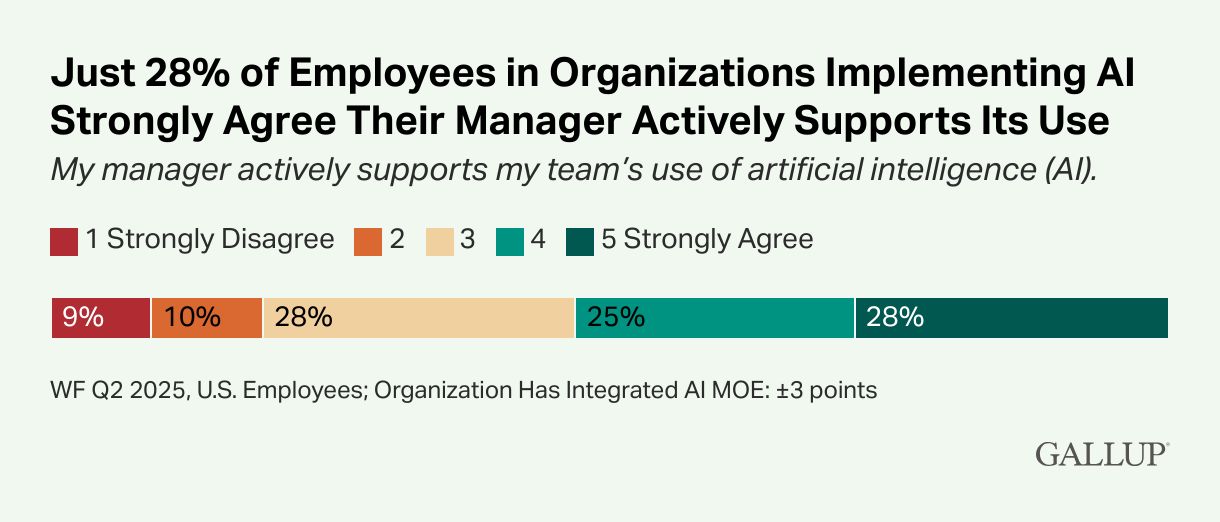
A fresh Gallup report published on November 8, 2025, drives this point home with compelling data: manager support is the single biggest driver of employee AI adoption. The study found that employees who strongly agree their manager actively supports AI use are more than twice as likely to use AI frequently, and nearly nine times as likely to say AI helps them do what they do best every day. Yet only 28% of employees in organizations investing in AI strongly agree that their manager actively encourages it. That's a massive gap (and a missed opportunity).
Leadership Sets the Tone (But Many Are Just Saying "More AI")
We've all heard executives (or private equity owners) pushing for "more AI" without clear direction: "We need to be an AI-first company!" But as the Gallup data shows, vague top-down mandates aren't enough. How leaders use AI themselves and talk about it dramatically shapes adoption.
Managers who model AI use, answer questions, and connect tools to real workflows see dramatically higher engagement. Without that active championship, employees disengage (even when tools are readily available).
Adoption is Still Surprisingly Low (And Misconceptions Are Holding People Back)
Despite the explosion of accessible AI tools, many workers aren't using them (or are only scratching the surface). Remember how long it took for universal Google adoption, even though it was dead simple? AI is proving even slower, compounded by trust issues and unfamiliarity.
Gallup found that among non-users, 44% say the main reason is they don't believe AI can assist with their work. That's a huge misconception. In reality, AI has applications for nearly everyone (from plumbers brainstorming repair approaches, to doctors reviewing research, to knowledge workers drafting reports or analyzing data).
Access isn't the biggest problem (only 16% cite lack of tools). The barriers are perceived relevance, training, and confidence.
We're Treating AI Like a Gadget, Not a New Way of Working
Many organizations haven't invested enough in training and enablement. Too often, AI is positioned as just another "tool" for delegating transactional tasks ("Hey, AI, write this email for me").
But that's thinking too small. What if we reframed AI as an army of tireless interns working alongside every employee? Suddenly, we're not just automating rote work (we're unlocking entirely new ways to create value: deeper analysis, faster ideation, better decision-making, and more time for high-impact activities).
To get there, organizations need:
- Clear communication from leadership about why AI matters and how it fits daily work
- Role-specific training that builds real skills and confidence
- Active manager involvement to bridge strategy and execution
- Policies that address risks while encouraging experimentation (generally I see way more focus on managing risk than boosting experimentation)
As our Georgia AI community continues these conversations, the Gallup findings are a clear call to action: if we want AI to deliver real transformation, we need to prioritize the people side (starting with managers).
Why I'm All In on Accelerating AI Adoption in Georgia
This is exactly why I co-founded the Georgia AI Alliance. I firmly believe that if more Georgia citizens and organizations can adopt AI faster and more effectively, it will put individuals and businesses at a significant competitive advantage in a rapidly evolving world.
When our people and companies lead in AI, it creates a ripple effect: higher productivity, innovation, new jobs in emerging fields, and stronger economic growth overall. Ultimately, that means more opportunities (better careers, thriving businesses, and a prosperous future) for Georgians and Georgia-based organizations.
Let's make Georgia a leader in the AI era. Join the conversation, share your experiences, and let's build this together.
What do you think? Are you seeing strong manager support driving AI adoption in your organization?